Don't Fall for Your Co-Star: The Secret Contract Language Hollywood Uses to Keep On-Set Romances From Blowing Up Their Biggest Films
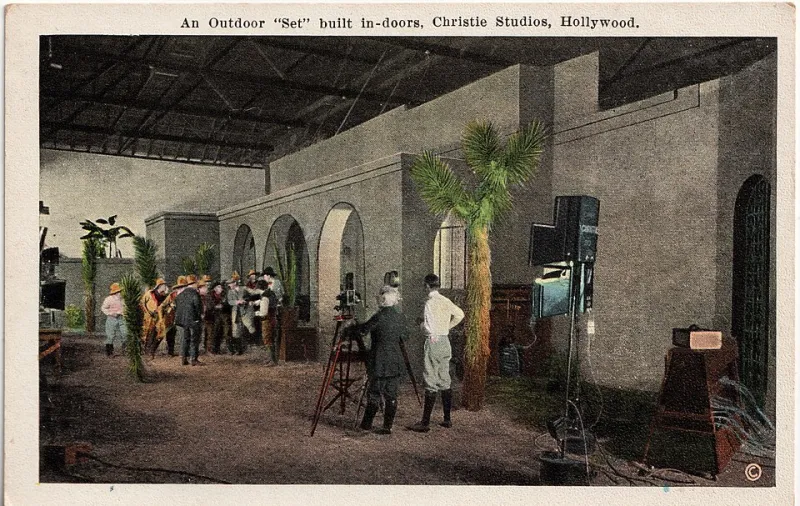
Photo: Glen G. Stone, Public domain, via Wikimedia Commons
Don't Fall for Your Co-Star: The Secret Contract Language Hollywood Uses to Keep On-Set Romances From Blowing Up Their Biggest Films
Somewhere in the fine print of a major studio production contract — buried between the morality clause and the social media approval rider — there may be language that, if you squinted at it long enough, essentially says: please do not fall in love with your co-star. Not in those words, obviously. Entertainment lawyers are paid too well to be that direct. But the intent, according to multiple industry sources, is increasingly present in the contractual architecture around big-budget productions, franchise films, and prestige TV series where the stakes of interpersonal drama are high enough to justify trying to legislate it out of existence.
Welcome to the co-star clause — Hollywood's worst-kept secret and, by most accounts, its least effective innovation.
The Problem It's Trying to Solve
To understand why studios started trying to contractually manage on-set romance, you have to understand what on-set romance has cost them. And the bill is considerable.
The entertainment industry has a long, well-documented history of productions derailed by the romantic entanglements of their leads. Some of those stories are now Hollywood legend — the kind of behind-the-scenes chaos that ends up in oral histories and documentary series decades later. Others are more recent and considerably less romantic in retrospect: sequels complicated by bitter post-breakup tension between leads who can barely be in the same room, press tours where co-stars who used to be partners give monosyllabic answers to questions about their 'great chemistry,' and franchise installments where a very expensive actor had to be written out or worked around because the personal situation had become professionally untenable.
The pattern is consistent enough that it has its own name in casting conversations. Sources who work in production describe it as 'chemistry risk' — the statistical likelihood that two attractive people, spending months in close quarters under the artificial intimacy of a film set, will develop feelings that create complications. And the bigger the production, the more expensive that risk becomes.
'On a $200 million franchise film, you cannot afford to have your two leads go through a messy breakup in the middle of a press tour,' one veteran producer told GlamDocket on background. 'It affects the marketing, it affects the audience's relationship with the characters, and it affects whether anyone wants to make the sequel. The math is brutal.'
What the Contracts Actually Say
The specific language varies by studio, production company, and the leverage of the talent involved — which is to say, the more powerful the star, the less likely any clause survives their lawyer's review. But according to entertainment attorneys who have seen these provisions, the contractual approaches generally fall into a few categories.
The most common is a variation of the standard morality clause, expanded to include language about conduct that could 'negatively affect the commercial value' of the production or create 'reputational or operational disruption' on set. This language is deliberately broad — broad enough to encompass a relationship gone wrong, though it would require a significant evidentiary threshold to actually enforce.
More specific provisions, reportedly used in certain franchise and ensemble productions, include requirements for advance disclosure of pre-existing romantic relationships between cast members, and in some cases, consent requirements before a new relationship between co-stars can be formalized during production. The logic, as one attorney explained it, is not to prevent relationships but to give the studio advance notice so they can manage the risk — or, if necessary, restructure the production around it.
There are also informal arrangements that don't make it into contracts at all. Casting directors and producers have described conversations with talent representatives during the hiring process that function as soft disclosures: 'We've had situations in the past that created challenges. We want to be transparent about that.' Or, more pointedly: 'These two have a history. Is that going to be a problem?' These conversations happen off the record, off the contract, and often off everyone's official recollection.
The Franchise Fallouts That Changed the Calculus
Several specific high-profile situations have been widely cited within the industry as the inflection points that pushed studios toward more formal management of co-star relationship risk.
The most discussed, at least in terms of documented impact on production, involve franchise films where the romantic arc between leads both on and off screen became impossible to disentangle. When those relationships ended — sometimes messily, sometimes publicly — the sequels suffered. Audiences who had invested in the real-life romance as part of the film's mythology found the on-screen chemistry suddenly unconvincing. Marketing teams had to navigate press tours where the 'will they/won't they' energy had been replaced by something considerably more awkward. In at least a few cases, franchise trajectories were meaningfully altered by the interpersonal fallout.
More recent examples include productions where an on-set relationship became public mid-shoot, shifting the media coverage from the film itself to the personal lives of its stars in ways that studios found difficult to manage. When the relationship between the leads becomes the story, the movie stops being the story — and for a studio that has spent $150 million on a movie, that is a very expensive problem.
The Chemistry Paradox
Here is where the whole strategy runs into its most fundamental contradiction: the thing studios are trying to prevent is also, frequently, the thing they're trying to manufacture.
On-screen chemistry — the ineffable quality that makes audiences believe two people are genuinely drawn to each other — is notoriously difficult to fake and notoriously easy to develop when two attractive, emotionally available people spend months pretending to be in love. The casting process actively selects for people who have natural chemistry. The rehearsal process deepens it. The production environment, with its long hours, isolated locations, and artificial emotional intensity, accelerates it.
'You're essentially creating the conditions for people to fall in love and then being surprised when they fall in love,' one casting director said, with what sounded like genuine exasperation. 'The clause is a little bit like putting a 'wet paint' sign on something and being shocked when someone touches it.'
This paradox is not lost on the talent side. Actors and their representatives are increasingly aware of the contractual landscape around on-set relationships, and some have become sophisticated about navigating it — disclosing relationships strategically, timing announcements to minimize production disruption, and in some cases, keeping relationships entirely private until a project wraps and the contractual obligations are satisfied.
Does It Actually Work?
The honest answer, based on the available evidence, is: not particularly. The history of major productions since studios began incorporating this language suggests that the clauses function more as a risk management checkbox than an actual deterrent. People fall in love on set at roughly the same rate they always have. The difference is that there's now more paperwork involved.
What the clauses have changed, according to some industry observers, is the behavior around the relationships rather than the relationships themselves. Stars are more careful about public disclosure. PR teams are more involved in timing and messaging. And the post-breakup management of on-screen partnerships has become its own specialized skill set — one that casting directors, producers, and marketing teams are increasingly factoring into their planning from the earliest stages of a production.
'The clause doesn't stop anyone from falling for their co-star,' one entertainment attorney said. 'What it does is give the studio a seat at the table when things get complicated. Whether that's worth the paper it's written on depends entirely on what happens next.'
What Happens Next
The industry is watching a few developing situations closely — productions currently in various stages of development or release where the personal dynamics between leads have already generated significant coverage. How those situations resolve, and whether the contractual frameworks around them prove meaningful, will likely shape how studios approach this issue for the next several years.
What's clear is that the appetite for some form of formal management isn't going away. As production budgets grow and franchise stakes get higher, the tolerance for interpersonal variables that studios can't control gets lower. The co-star clause, in whatever form it takes, is likely to become more common, more specific, and more aggressively negotiated.
And somewhere on a film set right now, two leads are looking at each other across a rehearsal room and feeling something that no clause in any contract was ever actually going to prevent.
Hollywood has survived a hundred years of co-stars falling for each other — the only thing that's changed is how expensive the paperwork has gotten.